
Outline
Subscribe to our newsletter!
Receive exclusive updates on Wiremind's products, customer stories, and all upcoming events.
Follow Us


Our AI Bet: Investment, Vision & What It Means for Revenue Management
Wiremind’s first-ever funding round comes with a clear priority: AI. But what does that actually change for transport operators, and for revenue managers who run their pricing every day?
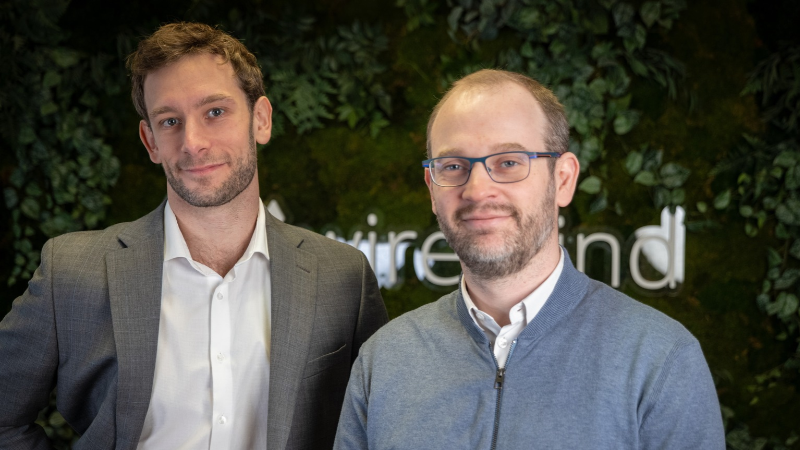
That’s the question Philippe Renon, our CRO, and Arthur Prager, our Head of Pre-Sales, answered at World Aviation Festival in Lisbon this year. The festival welcomed 4,500+ aviation leaders, but our own moment was more intimate: 30+ guests joined us for champagne, macarons and a short talk before the first toast. The topic: our AI bet. One week after announcing our €35 million funding round, our speakers walked through where that investment goes, from 12 years of in-house machine learning to a new layer of AI agents, and why analysts still make the call.
Capacity is Fixed. The World Around it Isn't.
Every revenue manager knows the starting point: once a flight or a train departs, an unsold seat is revenue that will never come back. That constraint hasn't changed. What has changed is everything around it, and Philippe opened with three shifts operators are facing right now.
- Demand is harder to read: events, seasonality and disruptions no longer follow predictable curves.
- Competition has become a price war: competitor responses arrive almost instantly, across a growing number of distribution channels.
- Rules alone can’t keep up: manual adjustments and rigid rule-based pricing are no longer enough, which is pushing the industry toward AI and continuous pricing.
The common thread is timing. A team that reacts to what already happened is always one step behind.
That is where our vision starts: redefining transport economics to make it highly profitable for operators and fair for travelers. For an RM team, that means getting ahead of the market instead of chasing it. CAYZN's forecasts pick up a demand shift before it shows in bookings. CAYZN Tracking flags a competitor's price move so the team can answer it the same day. The optimizer keeps re-optimizing prices as bookings come in, so seats that would have left empty get sold at the right price. That's the job we give AI: the models do the heavy lifting, and revenue managers keep their time for the calls only they can make.
Our main mission is to empower transport operators with the market’s most advanced AI-driven revenue optimization system. Through our products, we aim to deliver measurable value to every stakeholder, from Analysts and Executives to passengers:
- Time-saving & Accuracy: Internal users, Analysts, and Revenue Managers benefit from automation of manual tasks, AI-driven decision support, and a highly intuitive interface (UX).
- Growth & Profitability: Executive leaders, C-Level, and VPs get revenue maximization, highly reliable forecasting, and a clear competitive edge.
- Fairness & Accessibility: Passengers who are the end customers get fairer prices, better inventory availability, and seamless booking experience.
Why Accelerate Now?
On October 6, Wiremind announced €35 million in its first-ever funding round, with IronWave (formerly Wendel Growth), Bpifrance (through its Large Venture fund) and Seaya Andromeda joining as investors. We have been self-financed and profitable since 2014, and our co-founders, Colin Girault-Matz and Charles Pierre, remain majority shareholders. Opening the capital was a choice made from a position of strength, not out of necessity. In 2025 alone, revenue grew 67% and we signed 23 new clients, bringing us to 80+ operators, including SNCF, Trenitalia and Eurostar.
So the real question is timing. Philippe's answer: operators are adopting AI and making their technology choices today. The systems they select now will shape how they price and sell for years. The round funds two priorities that reinforce one another:
- International expansion in fast-growing transport markets across Latin America, Asia-Pacific and the Middle East, where those technology decisions are being made right now.
- Technology and AI, scaling our research in machine learning, optimization and large language models (LLMs) to make our products even more valuable to our partners.
It's also why this isn't "just another AI layer." Our own forecasting and optimization models have been running our clients' revenue management every day since 2014. The investment lets us accelerate the R&D behind them, and build what comes next on top of a foundation that's already proven.
12 Years of Machine Learning, Built In-House
Long before agents entered the conversation, AI was already at the heart of CAYZN. Since 2014, every model behind our forecasts has been designed, trained, and maintained in-house by our Research Lab: around 20 data scientists, including a dedicated research team, working alongside applied mathematicians who design our optimization algorithms.
Their starting point is simple: demand forecasting is the most important input to any pricing decision. If the forecast is wrong, the optimization can be mathematically correct but still miss the commercial target. That’s why our Research Lab’s work focuses on getting that input right, starting with the data. Before every training, the datasets are cleaned to reflect the right demand and flag outliers, so the models learn from what passengers actually wanted, not only from what was left to buy.
Then comes the harder part: going beyond correlation. Most machine learning learns patterns from historical data, but in revenue management, a pattern isn’t enough: teams need to know what actually happens to demand when the price changes. Our lab built an in-house causal inference framework that separates the effect of price from everything else that moves demand. In practice, we split the problem in three: one model for everything that isn't price (seasonality, events, booking pace), one dedicated to price, and one for elasticity. As a result, CAYZN learns price elasticity more reliably and holds up better when market conditions shift.
Our research doesn’t stay in the lab either. The team publishes its work regularly (read our latest research paper on arXiv), collaborates with academic partners such as the UBC Machine Learning Lab in Vancouver and LPSM in Paris, and shares its findings at industry forums like AGIFORS. It also runs at scale: about 750K+ automatic re-optimizations every day, powered by 53 models in production, selected from more than 18,000 trainings.
Every forecast stays explainable as well. Analysts can access the demand data, accuracy dashboards, and computation logs behind each recommendation, so they can trust the model and know when to challenge it.
Because analysts know their market best, choosing a strategy remains their call. The right decision depends on context a forecast can’t hold on its own: commercial targets, market positioning, what the network needs this week. So our models don’t choose; they show what each option would deliver.
Agents on Top of our ML Models
AI already automates a lot of the routine in CAYZN: our optimizer re-optimizes prices around the clock, without anyone having to press a button. The next step, in our view, is AI that also helps RM teams make better decisions faster, without taking the decision away from them. That’s why we’re building agentic AI, powered by LLMs, on top of the forecasting and optimization engine CAYZN already runs on.
This won’t be a new engine or a generic chatbot that is added to the platform. Our AI Agent Suite is being built around the everyday work of RM teams.
The agents don’t replace what CAYZN already does. Forecasting and optimization stay at the core, the agents work alongside them, and the analyst stays in charge. Each action has a clear role:
- Predict: Our in-house ML models forecast demand, and our optimizer works out what each potential strategy would deliver.
- Recommend: AI agents, grounded in Wiremind’s revenue management expertise, suggest the strategy that best fits the moment. In other words, AI that thinks like an expert revenue manager.
- Decide: In the end, the RM analyst makes the final call, with the agent’s recommendation in mind.
In practice, this means analysts can express commercial intent in plain language, such as “apply an early booking strategy” or “undercut the competition where possible,” and the agent selects the optimization setup that matches it best.
The first step of our AI Agent Suite is already live. Business Rules is one of the most powerful features of CAYZN, and one of the most demanding ones. Our new Business Rules Agent makes it simple by letting CAYZN users write, explain, adjust and preview business rules in plain language, with every change reviewed before it’s applied. Since its general release in June, it has handled close to 4,000 messages across 2,000 conversations from 120+ users at 15+ rail, air and bus operators, with usage growing every month.
Three principles guide everything we build in this layer:
- RM-native: Designed around transport revenue management workflows, not generic AI prompts.
- Explainable: Every recommendation comes with its reasoning.
- Human-controlled: Nothing is applied without the analyst’s approval.
The order matters. The agents don’t replace the forecasting models, the optimizer, or the analyst. Instead, they help analysts perform at their best by adding context and explanation between models and the people using them. This way, the team can follow a recommendation, adjust it or set it aside, knowing why it was made.
What it Means For You
Be it planes, trains, or buses that you run, our AI bet narrows down to three important things:
- Forecasts with a track record: The recommendation layer is built on models our own teams have run in production for over a decade, not on a generic model added after the fact.
- Less time spent making trade-offs: Analysts get a recommendation alongside the forecasts, so more of their time goes to the decisions that need human judgment.
- Control stays with your team: The agent advises, and your analysts decide.
Beyond the RM team, the goal is the same one behind our vision. For operators, that means more innovation, stronger revenue, and more reliable forecasts, now backed by GenAI in CAYZN. For passengers, that means fairer prices and better availability. Our headline of raising €35 million stems from our purpose to get to the goal faster. That’s the AI bet we’re making.
Thank you to everyone who joined us in Lisbon. To see how CAYZN’s forecasting, optimization and AI agents work together on your own network, book a demo with our team.